Dear all,
You’ve hopefully have seen the email on Friday from UCU Head office to confirm that strike action is now suspended: this includes action short of a strike (ASOS).
Let’s take a moment to look at what we’ve achieved.
· In January, despite our protestations, the JNC approved the change of our pension fund from DB to DC, and the next stage was going to be a consultation period with USS members. Following our action, this has been overturned and we have stopped the DC pension from being imposed – and we’ve achieved an agreement to maintain a meaningful defined benefit pension.
· We disputed the basis of the valuation and the amount of the alleged deficit. The employers refused to listen: but following our action, the valuation is being reviewedagain and an expert panel appointed to agree key principles for the future.
Those are the two big achievements: but the other things that we’ve achieved are:
· We all know an awful lot more about pensions than we did before – and so do our nearest and dearest (except those who bought ear plugs), our students, our non-member colleagues, our neighbours and the general public: and there’s been a rise in the number of articles in the media about pensions in the UK, not just in the higher education sector.
· We’ve brought to the fore the issues about commercialisation of the sector, about the links between fees and the sale of degrees, and about the factory effect of pushing students towards a final degree without giving room for creativity, additional thinking and genuine debate.
· We’ve highlighted the issues that exist for those joining academia, and theprecariousness of working at universities, and shown how much the university has moved towards fixed term, low paid, part time or zero hour contracts.
· We’ve shown how much the universities rely on our good will and willingness togo not just that extra mile, but the extra marathon.
· We’ve met colleagues from across the university and built a solidarity which crosses departments, subject areas, and internal structure.
· We’ve gained a huge number of new members, bringing fresh ideas and new energy and enthusiasm, and providing extra strength for our bargaining and negotiation power.
We will all be keeping a close eye on the slippery team at UUK to make sure they follow through on what they’ve said to date. We’ll be reporting back to you (as will UCU Head office) on progress. They will, on their part, be trying to spread disharmony and find ways of breaking our united front. Don’t let them. If they can find a way of splitting us and pitting one side against the other, then there is a risk we will lose what we’ve fought so hard to gain.
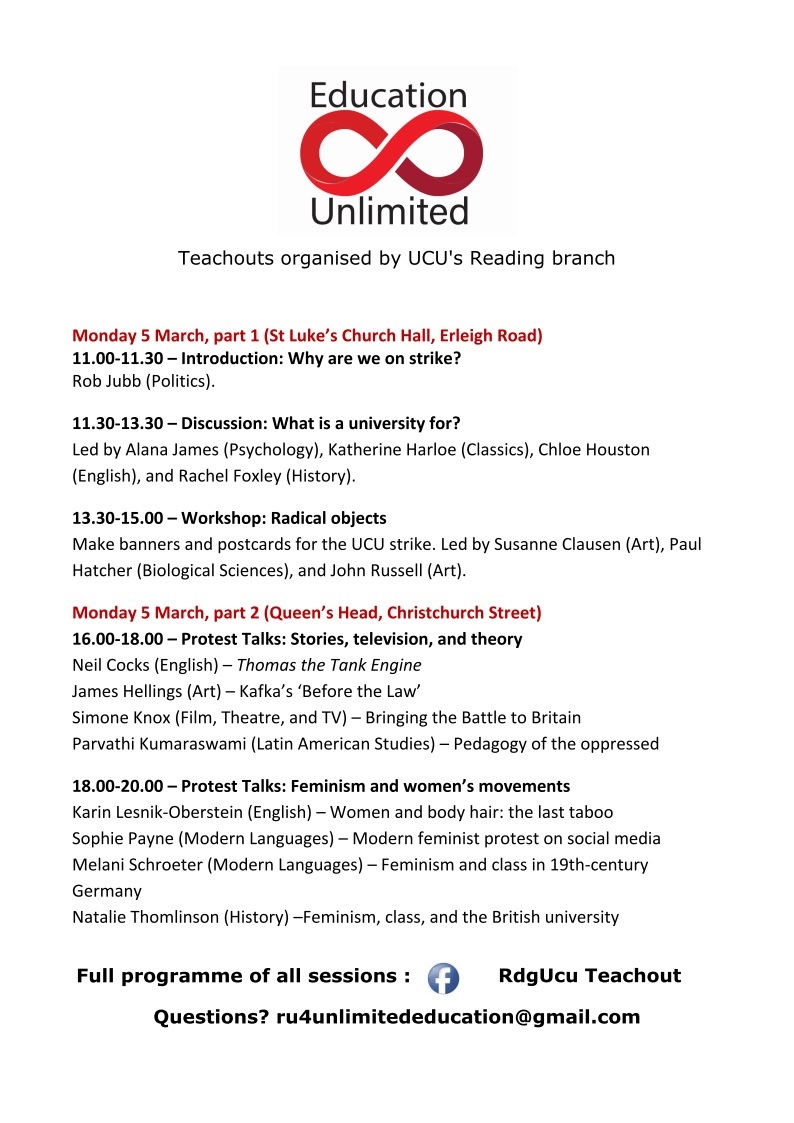
You’ve all been amazing, and I hope you’ll all feel that these are huge steps forward, when you think of how we were in the summer last year, regardless of how you may have voted in the ballot. Your hard work, your commitment and your willingness to sacrifice time, pay and energy have all paid off. For those who picketed or stood at the picket lines in support: thank you! For those who brought food and drink to the picket lines: thank you! For those who organised teachouts, led new Education Unlimited meetings, made badges, created placards, marched, played music or dressed up: thank you! And beyond us in the union, there are colleagues who said kind words in support, or who dealt uncomplainingly with an issue that would normally have been covered by a member on strike, or who beeped their horn at the picket line (never to be underestimated as a cheering moment): please do thank those colleagues too.
We’re back to work now: but please do remember that the University pays you to do a job, and that they pay you a certain number of hours to do this. Please don’t fall into the trap of offering unlimited free hours to them again. If, for example, you’re paid on a 0.2 contract, and you’re asked to prepare, teach and mark a module, and that amounts to 0.3 of your week, please make this discrepancy absolutely clear to your line manager and ask why you are not being paid to do the work you’re being asked to do. Contact us if you need support on this: but this is also something we’re going to be looking closely at in the coming months.
In September last year I emailed out to tell you what our strategy was for the year. We had held our annual Strategy Day, where we reviewed the last year and looked to plan what our resources should be directed towards in the coming year. We identified six priorities which were:
· Pensions (I think we covered that…)
· Workload – we’re looking at the amount of overwork amongst staff, and are collating data on this together with (anonymised) information on stress levels and health issues as a result of increased workload.
· Equality – we’re concerned about the lack of clear policies on equality, and are alarmed at some of the casework information that has come through where staff are finding that their own concerns are not being addressed with any robustness by senior staff.
· Insecure contracts – we have a clear sense that these are being used as a means to justify over recruitment: PhD students are being asked to teach with no contract, and staff are being asked to work on fractional or short term contracts where the number of hours paid is not enough to cover the number of hours worked; we’ll be talking more about this and seeking data from you.
· Pay and framework – we are campaigning for better deals for casual staff, career progression for all staff including Grade 6, arrest of grade drift, a fair hourly rate for staff. We are going to be asking for case studies and examples of unjust treatment.
· Recruitment – we need to keep recruiting, and we’ll be working on strategies to keep our numbers buoyant. We also need more help on the Committee and with casework, and are trying to find more department reps.
We certainly succeeded on the recruitment, too, with a huge 20% increase in numbers, and if you’re new since September you won’t have seen these priorities highlighted. We’re now going to be returning to the other items on the list, and picking up where we left off, with a particular push coming on both the gender pay gap and on insecure contracts. We welcome any offers of help on either of these, and we do have vacancies on our committee too, so if you would like to come and find out more, please get in touch. Let’s harness that commitment and energy and keep fighting to make sure that this is an amazing place to work, with amazing colleagues!
Sally
Sally Pellow
Secretary
Reading UCU