
Update to Reading UCU members on 12th October 2026

I am writing to update you briefly about the recent Joint University UCU (JUUC) meeting that took place on 22nd September. We have provided a similar update verbally at the recent ReadingUCU meeting. 

But before we do so, I want to alert staff to the forthcoming Consultation Group meeting (which will take place on 15th October and which RUCU will attend as one of the key negotiating fora). The agenda includes:

Item 3. Student recruitment update (the slides have been shared with UCU at the recent JUUC meeting)

“Item 4. Current restructuring activity (verbal update Director of HR)

Item 5. Support for change (UCU/SF to comment on anything else needed to support colleagues through change)”

Re: Item 4, we want members to be aware that Reading UCU are not being consulted (and have not been consulted in recent weeks) on ANY restructuring and therefore the use of the word “current” is being viewed by us with moderate caution. As members expect, your committee needs to be properly prepared for discussions. To allow for this, I have written to the HR director asking for a written copy of the verbal update on or before Monday 12th October, so we can digest and meaningfully represent our colleagues at the meeting on Thursday.

Item 5 could indicate that senior management wish to speak to us about something in the pipeline. While not wishing to alarm members when we are not in receipt of concrete facts, we also want to alert members to the possibility of such information being presented to us. Recent council papers refer again to the desire to shrink the professional services wage bill to 40% of the total staff budget. Such a move could entail restructuring. We are also aware of senior management envisaging a potential new Target Operating Model in DTS with implications for all staff across the university.

I am therefore alerting you to the possibility of us needing a single issue extraordinary general meeting of ReadingUCU on Friday 16th  to discuss any sensitive or urgent matters covered at the  consultation meeting, the potential drivers for restructuring and how the branch will respond and mobilise. This is to ensure that members have both information and control over next steps. If our worries come to nought at the consultation meeting on Thursday, we will not progress with the EGM.

We have learned from the USS dispute that if we fight, we create the possibility that workers can win what is rightfully ours. If we don’t fight against irresponsible ,unjust or incorrect management actions, workers will definitely lose. We will also set a bad precedent for our students and those who will follow us into academia by consigning them to worse working conditions. Fighting back through the use of industrial measures is painstaking work. Such work by its very nature has to be measured, methodical and member-led for it to work well, and as a branch, we will only engage in strikes or similar when we are absolutely sure that other mechanisms for putting pressure on senior management and ensuring change are not working without such industrial leverage….. more on this if/when we need to take action...

But I return now to the JUUC discussions last week and will set out some of the salient points.

This was an unusual interim JUUC held at our request, because there was otherwise a long gap (May 2026 to Nov 2026) with no scheduled JUUCs at a crucial time in the University calendar. It took some pushing at our end to encourage colleagues to recognise the importance of having such a meeting.

The Vice Chancellor typically leads the management side at such JUUC meetings, but a few minutes after we arrived, we received news that the VC had unfortunately been taken unwell, and that Prof Zaum would step in for him. So, Prof Zaum and Claire Rolstone, Director of HR represented management at this JUUC.

Although many topics were discussed at the JUUC, we want to draw a few salient points to your attention:

  1. After the preliminaries, Prof Zaum informed JUUC that further to an internal governance review, senior management had come to a decision that there would no longer be full and detailed minutes recorded for any committee including JUUC except for Senate and Council. The JUUC would therefore no longer be minuted with immediate effect, and we were told we would get a summary note instead. RUCU pointed out that on a joint committee with an external body such as UCU, this could not be a unilateral senior management decision. As you can imagine it is crucial that JUUC meetings are fully and carefully minuted, both for evidentiary and for accountability purposes and to safeguard the possibility of factual reviews of industrial relations discussions at points of disagreement. Further to us pushing back very firmly, the HR director suggested that she would work with the committee secretary to give us a copy of the ongoing JUUC meeting in the new note-taking format, and once we saw that we could then consider whether we supported or opposed the decision. We then moved on.

Comment: While we are always open to considering new ideas and options, our openness should not be mistaken for weakness. There is no vacillation on this point of needing full and formal minutes. For a whole host of reasons including transparency, accountability, and good practice in industrial relations matters, RUCU cannot and will not accept the non-minuting of JUUC meetings or of any other formal meetings it holds with university senior management, especially if these are negotiation meetings. Our subsequent member meeting last week underlined members’ agreement with our position that such non-minuting was not acceptable and that it would be unwise to allow senior management to unilaterally impose these changes.

  1. We formally raised concerns (in detail and not replicated here but explained at the branch meeting) regarding the poor treatment of colleagues in DTS. This follows a specific meeting that the branch president had with DTS members where these issues were discussed and we heard rather disturbing feedback from our colleagues. We alerted management to the serious risks emerging from the poor workplace culture that DTS staff are being subjected to. We also raised concerns about the implications of this stress on DTS colleagues, and its impact upon staff across the University. (We have subsequently passed a branch motion on this at our recent well-attended branch meeting)

  2. We also drew attention to the resource cuts in areas such as Student Services and the concerns that have been raised re: the impact on how we support students, especially at this time of the year. We expressed concerns about the mental and physical health tolls on staff of stress and overwork. More generally we raised a range of concerns arising from austerity, cuts and the ongoing job freeze across Professional Services functions. We specifically questioned the ongoing need for the job freeze given the information emerging on student recruitment (which had been advanced as the basis for the job freeze). We will return to this at our next meeting when the picture on numbers is clearer.

  3. We had a high-level discussion on student numbers based on emerging undergraduate recruitment data. We are still awaiting the PG data in the coming weeks and have a meeting scheduled at the end of October to look at the picture more holistically. We have also agreed to a follow-on meeting with Professor Zaum to take a more detailed look at student numbers.

  4. Given senior management plans to increase our footprint in India, (not much further detail was forthcoming at this stage), we asked for a full costing of UoR Malaysia efforts since inception and details of any lessons learned that would then be applied to considering overseas efforts including in India.

  5. We reiterated our wholehearted support for the belated but welcome effort that will ensure that those below grade six have the same holiday entitlement as those above grade six. We support this sr management initiative not just because we have amongst our members many in these grades even if we do not engage in collective bargaining below grade 6. We also support this change because, as a trade union, we are committed to fair pay, terms and conditions, and dignity in retirement for all workers. We drew management’s attention to the need to ensure that workload is proportionately scaled back to match the loss of working days for colleagues below grade 6 and alerted management to plan accordingly given the understandable knock-on effects on deliverables for other colleagues across the University. Otherwise people will end up doing the same work in fewer days, thus adding to stress and overwork. We also asked management to think about how this new holiday provision will affect projects and other support that our academic-related, professional services colleagues give students and staff.

In parallel, we raised the issue of those returning from sick leave or those purchasing annual leave, having the right to a reduced workload to match the sick leave or holiday taken.

We used this opportunity to encourage management to reconsider the lack of parity in pension provision for those below grade 6 compared to grade 6 and above (currently staff below grade 6 are typically in a DC scheme with 5% employer contributions) . We encouraged management to consider enrolling staff below grade 6 (should staff so wish) in a defined benefit pension such as USS or similar with strong employer contributions. We believe that all staff can and should have dignity in old age and peace of mind. Pay inequalities, as members well know, are manifested even more intensely in pensions. So it is particularly important that those who are in the lower pay grades benefit from a secure and well-funded pension.

We will report back to members after the consultation meeting on Thursday. In the coming days, we will also share with members some highlights of the themes emerging from our recent request for feedback in writing. We had asked members about the ways in which the expertise and experience of colleagues is valued across the divisions and functions of the University.

Best wishes

Deepa

(Branch President – ReadingUCU)
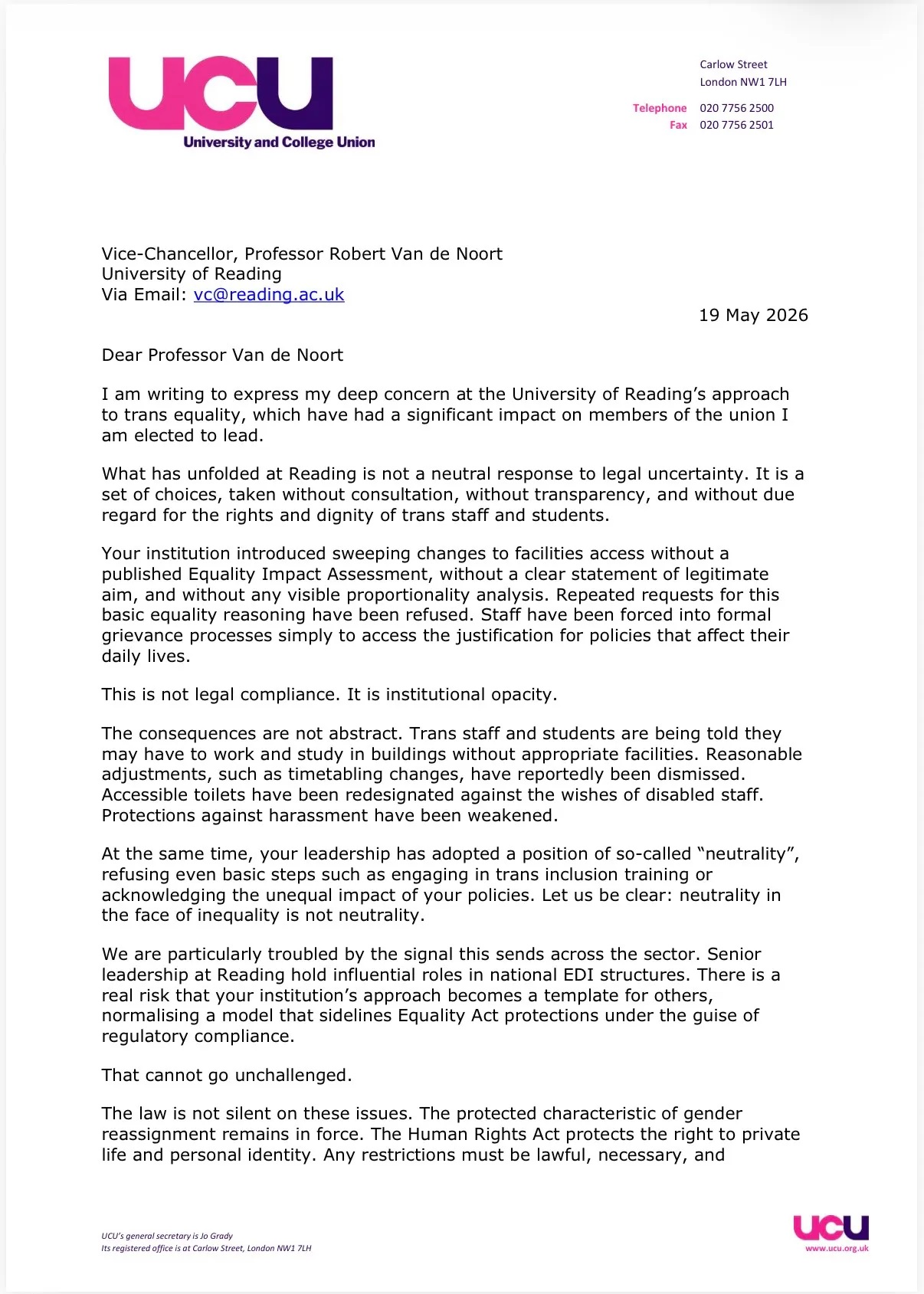
RUCU Motions Carried: OGM 06.10.26

Motion 1: Staff concerns – austerity, cuts and pressures on staff

This branch notes that

  • staff at the University of Reading are experiencing significant pressures, as a result of cuts and austerity
  • members tell us that these pressures are particularly acute in professional services areas and are a predictable result of the implementation by senior management of a range of measures including the non-replacement or delayed replacement of staff who retire or move on.
  • excessive workloads are made worse by the ongoing job freeze in professional services. (DTS staff for example are currently under particular pressure which has wide knock-on effects, especially at the start of a new term). We are also concerned by what appears to be a misguided resource investment in technology solutions, including AI, for mythical efficiency gains while staff are struggling with under-resourcing in crucial areas
  • due to the interconnected nature of work within a university, academic staff are impacted not only by cuts to their own departments and schools but also by cuts to academic-related and professional services staff and increasing expectations and heightened progression requirements. A good example is the sudden introduction of the demand for research active staff to bring in increased funds without recognising the time it takes to deliver research outputs.
  • ReadingUCU committee have formally tabled staff concerns (including specific concerns re: governance, culture and hiring decisions within DTS) to senior management at the recent Joint University UCU Committee (JUUC) meeting.


This branch asks the vice-chancellor and Council

  • to acknowledge the detrimental effects of the current austerity measures and the impact on students and staff
  • to put in corrective measures so as to immediately and effectively address the issues raised by staff, including via the Reading UCU at JUUC


Reading UCU resolves

  • to continue to oppose management approaches to resource allocation that prioritise investment in external consultants and providers (including a rush to deploy ‘AI’) while management simultaneously denies resources to the very staff who are the backbone of our educational efforts
  • to resist efforts that are couched in the language of “efficiency” and “excellence”, while engaging in lowest common denominator resources for the core functioning of the university
  • that if there are attacks on jobs or conditions including redundancies, the branch committee, will coordinate a university-wide response so as to draw on our collective strength
  • that the branch will not leave individual departments or functions to fight on their own against well-coordinated and well-resourced efforts by senior management that undermine our jobs, terms and conditions.


Motion 2: Solidarity with striking branches in Scotland

This branch notes that

  • Dundee UCU are now in week 3 of five weeks of strike action.
  • Dundee UCU have now been joined by Edinburgh UCU, in their own five weeks of strikes.
  • Staff are taking action against threatened compulsory redundancies, as Scottish Higher Education is embroiled in a governance and funding crisis.


Reading UCU believes

  • that these disputes are important battles for the whole union.
  • the employers will be watching what happens.
  • the absence of a national fightback by UCU leaves branches to fight on their own and reduces pressure on government bodies to step in to stop the cuts.


Reading UCU resolves

  • to send messages of solidarity to all Scottish branches in dispute.
  • to donate £300 to the hardship fund of Dundee UCU
  • to advertise public meetings, events and protests organised by branches under attack.
  • to continue to support the policy position agreed at UCU Congress to ensure prompt and meaningful industrial pressure on all decision-makers so as to prioritise and defend staff and students.


Motion 3 – Potential de-recognition of Brighton UCU

This branch notes that:

  • Brighton University senior management is threatening to engage in extreme union-busting by threatening UCU with de-recognition while re-negotiating their local recognition agreement.
  • such behaviours are a response to Brighton UCU’s strong record of opposing gratuitous redundancies and resisting poor management.


This branch resolves to:

  • Send a message of support to Brighton UCU and add our voice to the efforts for recognition of their local dispute as one of national significance.
  • advertise and support public meetings, events and protests organised by the branch


RUCU Update to members on 26th August 2026

I am writing to get an understanding from you of the issues staff are facing across the university. We are receiving some worrying reports regarding the treatment of our colleagues. Members are reporting issues with flexible working and office access, as well as cultural and managerial issues around bullying, lack of regard for staff expertise, changes to work without consultation or even explanation; and repeated and persistent failures with respect to implementing Occupational Health recommendations. 

The issues we are hearing from members include:

  • excessive use of bought-in expertise, systems and expensive consultants causing increases to fixed costs and recurring costs, at a time when there are constraints being imposed on costs.

  • experienced staff being discouraged from asking questions and being subjected to arrogant treatment resulting in poor managerial decision-making and adverse long-term consequences for students and staff

  • fear arising from news of a possible restructure and whispers / expectations of a “shake-up”, despite no notification to the recognised trade union in this regard. Here, we wish to remind members of the recent Employment Rights Act changes that further increase the protective award when employers fail to engage in meaningful consultation. Please do not hesitate to document any such concerns, and to raise them with Ellen (ellen.ucu@proton.me ), Deepa (deepadriver@protonmail.com ) and Colette (cmaxfield@ucu.org.uk ). Please do include your UCU membership number in your email so we can locate your details more easily. We encourage members to use a non-university email address to communicate such matters.

  • colleagues being given inconsistent information and members feeling like some managers are essentially “making stuff up” when responding to staff queries resulting in differential treatment and concerns about unfairness.

To unpack this further, we have a few questions for you. The queries below are not intended as a detailed survey, but our aim is to understand your bigger picture concerns a bit better, and we will then look more closely at targeted areas or topics in a systematic and detailed manner. As the questions below do not form an exhaustive list, please feel free to add further information as you see fit.

Please do not feel you have to include any specific identifying details but it would be useful to us to know which directorate/function or department/ Division you work in.

  • ⁠Do you feel your expertise and experience are valued and effectively used by your line manager?

  • Do you feel your team’s expertise and experience is valued and effectively used by university senior management?

  • Does your manager adequately include you / your colleagues in key decisions that affect your day-to-day work?

  • Do you believe university senior management adequately includes you / your colleagues / your UCU reps in key decisions that will affect your day-to-day work?

  • Is your area appropriately staffed and do you have adequate resources to do your job?

  • Are you experiencing unreasonable levels of stress in your day to day work?

  • ⁠⁠Is workplace stress adversely affecting your physical and/or mental health?Is this a more generalised picture of sentiments or concerns in your department, division, function or directorate?

  • How do you feel about your future at the university?

  • If you had a ‘carte blanche’, what reasonable steps would you ask local management or university senior management to take to improve your working conditions, or that of your team.

Please respond by email with your thoughts to Ellen (ellen.ucu@proton.me ), Deepa (deepadriver@protonmail.com ) and Colette (cmaxfield@ucu.org.uk ). Please copy all three of us, to ensure your email is picked up during leave or non-working days.

We will also arrange an online drop-in for members wishing to discuss such matters.

Now, onto some of the ongoing matters we are working on (for brevity, this is not an exhaustive list) –

  • We are still awaiting a confidential report re: the outsourced internal auditors’ review around matters such as the financial challenges. This prolonged delay is something we want members to note for discussion at the next branch meeting. Of course, alongside the substantive issues within the report itself which cannot be discussed yet with members for reasons of confidentiality,are the issues of lack of access preventing us from being able to meaningfully represent member interests. We will continue to press for this report to be made available to us, as we know how these financial issues have a huge bearing on restructuring, resource allocations and redundancies.

  • Our next discussion with the Chief Financial Officer is on 10th September. Members and reps who wish to share questions with us based on information gleaned through other sources including Council papers (see below instructions on how to access these – all staff should request access), should please let us know sooner rather than later, so that we can get meaningful answers at the meeting.

  • We will meet with the HR Director for a discussion about Academic Probation allied to discussions on progression etc

  • We will also meet with the HR Director regarding proposed changes to the professional services staff contract. The senior management position is that the changes they are proposing are intended to make the PS contract consistent with the academic contract. We are yet to finish our own independent reviews and will only enter into negotiations once we are satisfied that we understand the implications of various changes(members can expect to hear more from late October onwards). We remain committed to member-led democracy in our branch. After negotiations, any changes will be shared with members for consideration, before we agree anything.


Best wishes

Deepa


(Branch President, Reading UCU)

Additional Information :

How to access Council and Senate papers and understand the student recruitment position at the University

 If you haven’t already requested access we encourage all members to request access to and regularly scrutinise these papers so we have a good understanding as a branch of senior management plans. The process is linked on this page: Governance zone – policies at the University of Reading under ‘Availability of Council and Senate papers’.

The agenda and supporting papers are available for consultation by any member of staff, with the exception of reserved business and any items that are deemed confidential. The agenda and papers are published online via a portal prior to each Council and Senate meeting. Please email governance@reading.ac.uk if you would like to receive access to these papers.

University Planning and Strategy Office (PSO) – Access to data

The University Planning and Strategy Office (PSO) have made available a new data dashboard hub to all staff. It includes dashboards and reports covering Student admissions and enrolment; Course performance and progression; Research activity; and Diversity and inclusion data. If you don’t yet have access, you can request it  by emailing planningandstrategy@reading.ac.uk.

The PSO Planning & Reporting team will also be giving a series of brief, in-person presentations across their data.

The sessions will be running on Wednesday 16 September and Thursday 17 September from 12-2pm.  Each session will include a brief 10-15 minute presentation followed by a Q&A or you can nip out before the Q&A to catch another presentation! Registration will be required for presentations but there will also be a drop-in clinic available without booking.Please visit the PSO Data Shares Event page for the schedule and to register for sessions. Email planningandstrategy@reading.ac.uk if you have any questions

Dr Deepa Govindarajan Driver
Deepadriver@protonmail.com
Twitter @deepa_driver

Update 6th August 2026

It is clear to us from emails, questions and comments shared with us in relation to the July all-staff talk with UEB that staff are very worried about the consequences for staff and students arising from the Professional Services hiring freeze and from senior management plans to further reduce the amounts spent on staff costs (both academic and PS).

Your questions and comments are informing our discussions with senior management and importantly are shaping our strategy to resist any unjustified cuts in 2026-27. Colleagues who may have missed recent emails can find our key areas of concerns set out on the emails from your branch committee dated July 17th and July 20th (the latter containing specific high-level points).

During the 21st July  all-staff talk, the VC asserted that there are no plans for large scale cross-institutional redundancies at Reading, but as we well know, such assurances come with giant caveats. The VC noted things could change (as one might imagine) and also that due to the scale of ‘savings’ needed during 26-27, redundancies as part of targeted restructurings are really possible.

While the VC noted that nothing is yet finalised, he also stated that UEB would be working on a number of these changes over the summer. We are paying close attention to this and to refining our branch strategy accordingly, especially given that some members are currently using well-earned leave.

Any redundancies, if they do arise, will need to be accompanied by formal steps for consultation with the trade union. So please continue to alert us if you or colleagues are approached in this regard or if you see any red flags over the summer.

We have had a helpful meeting earlier this week with the Chief Financial Officer, to discuss the accounts. It is early days yet but a further meeting with him is now in the diary for September and we are expecting to meet on a monthly basis till the issues are bottomed out. We are still awaiting from the VC a confidential report re: the outsourced internal auditors’ review around matters such as the “financial challenges”.

Members should be assured that while we do seek details to ensure accuracy, your committee remain focussed on big picture questions. Your committee is also very clear that we must be open-minded while at the same time thinking critically about senior management assertions (rather than accepting them at face value). For example: Does it make overall sense to us when senior management say that we have achieved and surpassed our budget target for 2025-26 while at the same time saying that they wish to deliver even more reductions to staff costs in 2026-27 (ie that if we are thinking of this as something of a marathon journey that ends with wiping out the so-called deficit, we are now already further ahead than we should be at this point in the race and we have surpassed the so-called deficit reduction targets at this point. Is it fair or indeed sustainable that staff need to run faster at this point and deliver even more cuts?. How does all this make sense if senior management are authorising spending of large amounts on system upgrades or building costs (URS), or external consultants, while demanding that staff continuously tighten belts?

Members (and the committee) should not and will not be very sympathetic to senior management trying to paint our hard-won savings as grounds for further accelerated cuts to staff costs, simply because they would now like to prioritise spends on consultants, building costs and IT systems? A further email will follow about our views on this as we reconcile the figures.

Staff continue to write to us to share deep concerns regarding the excessive spend on consultants in a number of PS areas, and we are acutely aware of the pressures being put on technology teams on the ground to deliver changes at an accelerating speed. Detailed committee discussions with management on this continue, and we will share further information in due course. But the scale of the costs for external consultants that we have seen so far is eye-wateringly large, and vindicates member worries.

Your committee has asked and received confirmation that the Staff Student Ratio (SSR) methodology that is informing UEB  decisions with respect to the reshaping of academic areas, has not been refined further since the last version we scrutinised last year. This is definitely giving us pause for concern as this methodology has been shown by our members to be disconnected from the realities on the ground. The SSR should not be being used as the basis for cuts, until rectified and made much more robust. Members need look no further as to its flawed logic, than the brutal cuts in Chemistry at UoR, using these very rough SSRs as part of the public rhetoric.

Working more efficiently and using automation or AI appears to be the new mantra from senior management, particularly in PS areas. We have highlighted to senior management, staff concerns that, especially in technology-related decisions, this push for efficiency has actually resulted in management spending more and more money on new (and what seem to us to be poorly justified) technology providers, and replacing perfectly adequate (if not perfect) technology systems with brand new and much more expensive ones. What is also concerning is that these changes are tying the university into very expensive, new, recurring contract costs from IT providers. Members have raised with us concerns that all this appears to be being done in ways that are pushing colleagues very hard (and causing associated health and safety problems) towards even burnout and by ignoring the voices of specialist colleagues who are cautioning management against such changes. There is a valid concern that plans to make these drastic changes are based on a flawed logic. While the plan is ostensibly to replace old systems and drive efficiencies by bringing new ones that are compatible with the planned AI overlay, all this rests on overestimating what AI can really deliver. There are also the huge additional costs which mean that the only people who will benefit are the IT consultants and software providers earning recurring fees, and not our staff or  students.

Since my last email to you and indeed over the past months, your committee has also been working carefully on branch matters including efforts to address casualisation, discrimination and we also continue to contribute to discussions re policy changes. We know that these policy points (whether on progression, or disciplinaries etc) can adversely affect colleagues’ day-to-day working lives, especially if the union does not pay sufficient attention. We are grateful to departmental reps, activists and caseworkers who help us grapple with these.

Your committee will continue to send you regular emails to keep you updated of any evolutions to the big picture. I hope those of you (especially PS colleagues) who are working very hard over the summer period know we are conscious of your efforts, and that those who are taking some time off actually manage to get some rest. Please continue to write to me cc’ing Ellen and Colette.

Best wishes

Deepa Driver

(Branch President, Reading UCU)

Summary of important developments affecting staff

For ease of reference, we have highlighted below some important snippets from the recent communication from senior management via the staff portal as we believe it has potentially grave implications for all staff and students.
  1. “Plans for the coming financial year already had embedded savings of £21.2m, in order to reduce our operating deficit from £33.1m in 2025/26 to £22.3m in 2026/27. More recent financial forecasting has shown that a further £11.3m of savings will now be required during 2026/27 to achieve the agreed deficit.”
  2. “As well as an element of ongoing external volatility, these additional savings largely reflect issues highlighted during development of the budget, including inconsistencies found between the planning and budget processes. Thanks to the very detailed nature of our budget setting process, these were identified so that an up-to-date picture could be considered by Council.”
  3. “The scale of savings required means the financial challenge facing the University has become greater than previously expected.”
  4. “The plans signed off by Council include tighter control of spending on central projects, goods and services, and continued investments in both systems improvements and income generation activities.”
  5. “Alongside this, significant savings will be required in both Professional Services and Academic Schools, supported by investment in activity designed to create more efficient ways of working.”
  6. “However, vacancy controls alone will not deliver all the savings required. While no redundancy programme is currently planned, restructuring cannot be ruled out as plans are developed.”
  7. “…This has to include applying our reserves to strategic development rather than continuing to rely on reserves to maintain a deficit position”
The full senior management communication can be accessed here https://portal.reading.ac.uk/staff/all-news/2026/july/Savings-plans-for-2026-27 and, in case you missed it you can find further information from ReadingUCU in our email update to members on 17th July
We want to hear from you and welcome your comments and thoughts. If you prefer to speak to us, rather than email with any detailed thoughts, please let us know at the above addresses and we can arrange a phone call.
Also, for the avoidance of doubt, the branch committee are happy for members to share this email as well as our email dated 17th July with all staff at the University of Reading.
In solidarity
Deepa
(Branch President, Reading UCU)

Important Update for RUCU members

Your ReadingUCU branch committee reported back to union members (at the OGM) on the recent (overarching) consultation group meeting where we met with management  earlier this week . At this meeting with management, we discussed the (fully redacted) Transformation plan that was taken to Council. We discussed with management the proposed reduction of the professional services pay packet to a much smaller fraction of the total staff pay envelope.
At the OGM on Tuesday and subsequently, we examined with members the implications of this for colleagues in all roles. With reps, we have started to unpack both the supposed rationale and the next steps around how our branch intends to respond.
We are now writing to alert you to an important new announcement that senior management has made on Wednesday, that has potentially grave implications for all staff and students. https://portal.reading.ac.uk/staff/all-news/2026/july/Savings-plans-for-2026-27
As a small but crucial aside, we do intend to ask senior management how their transparency commitment, and their commitment to engage in meaningful consultation squares with not even mentioning this to us on Monday when we met.
There are many layers to the sentences in the announcement and no doubt more clarity will emerge in the coming days . Specifically, we want to alert members to certain segments, that we will be particularly interested in probing further.
  1. “Plans for the coming financial year already had embedded savings of £21.2m, in order to reduce our operating deficit from £33.1m in 2025/26 to £22.3m in 2026/27. More recent financial forecasting has shown that a further £11.3m of savings will now be required during 2026/27 to achieve the agreed deficit.”
  2. “As well as an element of ongoing external volatility, these additional savings largely reflect issues highlighted during development of the budget, including inconsistencies found between the planning and budget processes. Thanks to the very detailed nature of our budget setting process, these were identified so that an up-to-date picture could be considered by Council.”
  3. “The scale of savings required means the financial challenge facing the University has become greater than previously expected.”
  4. “The plans signed off by Council include tighter control of spending on central projects, goods and services, and continued investments in both systems improvements and income generation activities.”
  5. “Alongside this, significant savings will be required in both Professional Services and Academic Schools, supported by investment in activity designed to create more efficient ways of working.”
  6. “However, vacancy controls alone will not deliver all the savings required. While no redundancy programme is currently planned, restructuring cannot be ruled out as plans are developed.”
  7. “…This has to include applying our reserves to strategic development rather than continuing to rely on reserves to maintain a deficit position”
Since the announcement, your committee has had internal discussions within  the committee and has met with reps, In addition to substantive concerns about governance, jobs, students and workload, we remain concerned that the statement contains opaque numbers and that it does not reflect the gravity of the consequences for staff and students.
We recommend that all staff seek clarity and particularly listen out for subtext, during the rescheduled All Staff talk : Q&A session that will be hosted by senior management on Tuesday next week.
We would also be grateful if members (and indeed any concerned staff) could drop a quick note with thoughts on or concerns about the points in the Staff Portal message listed above.
Also, please let us know about H&S issues that you can see arising in your area from the senior management plans – please copy in Rita, RUCU H&S rep and Workload officer, if your email includes H&S concerns
Please also feel free to alert us to any matters including governance concerns or specifics in your local area, that you want us to pay particular attention to, as senior management start to unfold their plans.
FYI, UCU represents all staff grade 6 and above for collective bargaining purposes. A number of our members come from other grades at the University and we continue to value their contributions to the union, and support them in important areas including individual case work and more.  
 
We look forward to hearing from you
In solidarity
Deepa

(Branch President – ReadingUCU)
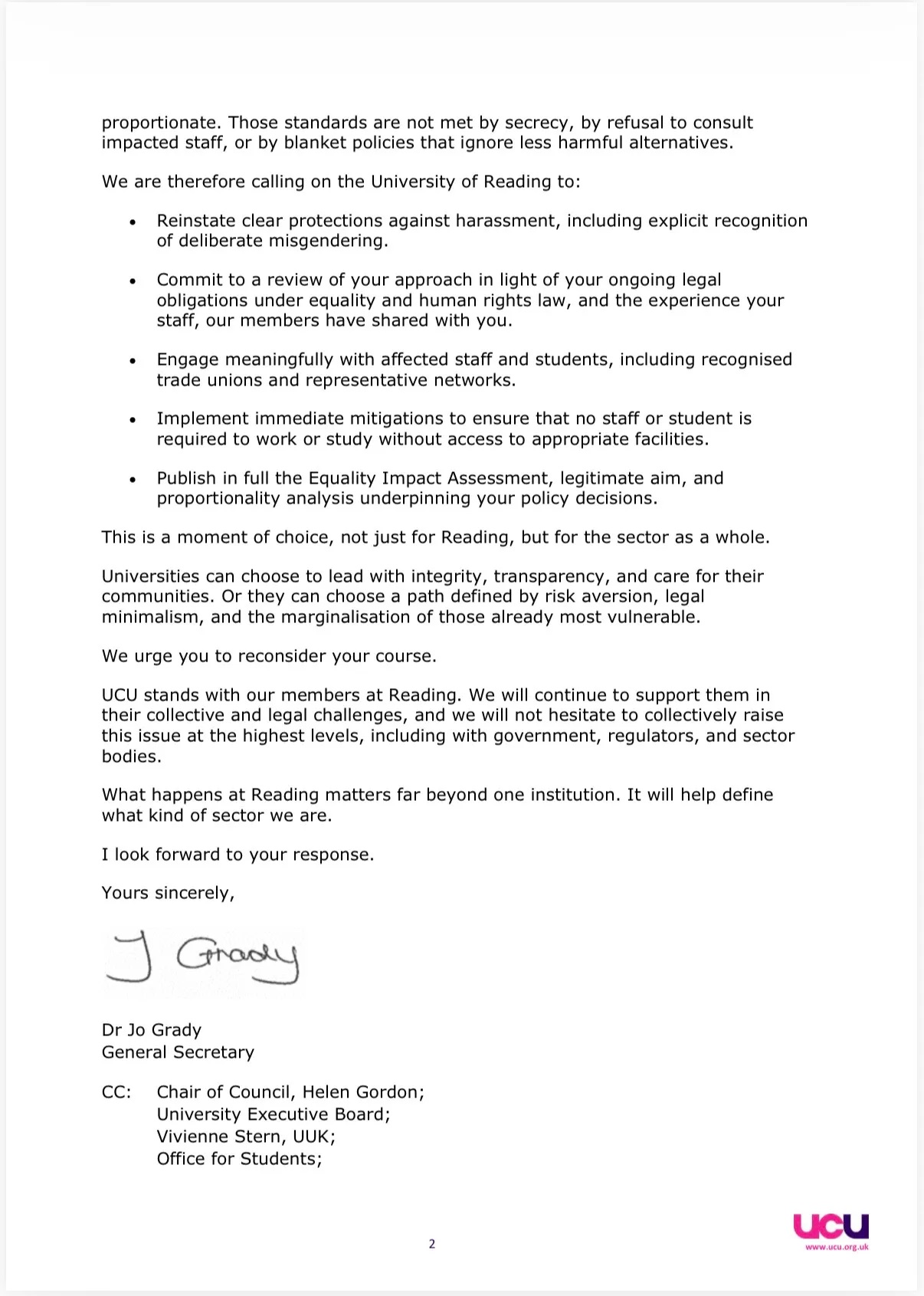
RUCU Motions Carried: OGM 14.07.26

Motion on Solidarity with LSBU UCU

Reading UCU notes the serious attack on the jobs of staff at LSBU UCU branch.   

Reading UCU resolves   

  1. To send a message of solidarity to LSBU  
  2. To pledge to donate £250 to the hardship funds of LSBU   

Motion: University of Sheffield Global Academic Boycott

This Branch notes: 

  1. That national UCU has called for a global academic boycott of the University of Sheffield in response to Sheffield management’s repeated imposition of ‘double deductions’, whereby staff who took industrial action to protect their jobs and fight the cuts have been subject to further deductions if they refused to make up teaching lost to industrial action. 
  2. That the boycott called for by national UCU includes: 
  • To refuse to speak at or organise academic or other conferences at the University of Sheffield 
  • to refuse to give lectures at the University 
  • to refuse to accept positions as visiting professors or researchers at the University 
  • to refuse to accept new contracts as external examiners for taught courses at the University 
  • to publicly decline honorary degrees/doctorates from the University of Sheffield. 

The Branch believes that: 

  1. the University of Sheffield’s actions demands a strong and coordinated response and solidarity across branches 
  2. attacks on trade‑union rights at any university threaten the entire sector supporting the boycott signals that the sector will not tolerate punitive treatment of staff

    The Branch resolves: 
  1. to publicly endorse and participate in the global academic boycott of the University of Sheffield, as called for by national UCU. 
  2. to call on branch members to observe the boycott guidelines 
  3. to send a message of solidarity to Sheffield UCU 
  4. to pledge to donate £100 to the hardship fund of Sheffield UCU 


RUCU Motions Carried: AGM 16.06.26

Motion 1: Defend all staff with particular attention to professional services (PS) and prioritise the education motive at the University of Reading

ReadingUCU notes

1. that the HE market crisis continues, with 15,000 jobs lost last year across UK HE

2. the need for serious restraint and responsible spending in the current circumstances, which appears to be contradictory to approval given by Council in March 2026 for £47m capital expenditure towards URS renovation and expenditure on consultants (data pending)

3. the developing research funding crisis triggered by UKRI ‘rebalancing’

4. lessons learned from the Gillies report into the University of Dundee’s financial crisis and the implications for our university. The report found failings were compounded by the top-down, hierarchical and reportedly over-confident style of leadership and management, a lack of transparency and clarity in respect of financial information.

5. reduced provision on degree and Masters programmes including after the Portfolio Review Pathway (PRP) at University of Reading

6. the latest email from the PVC Prof Dominik Zaum (Update on recruitment, finances and next steps) and the message from senior management covering  imminent possibilities for “significant change” in professional services

7. the initial meeting between ReadingUCU branch committee members and Prof Zaum and Claire Rolstone (HR)

ReadingUCU resolves

a. to strongly oppose management approaches that may indicate that ‘AI’ replaces the role of and need for staff focussed on good quality education, especially professional services staff.

b. to insist on recognition by UoR senior management that professional services staff form the backbone of our educational efforts at the University of Reading, and that their experience and insight is key to our shared work

c. to defend equality of access to diverse degrees and disciplines across the UK and all PS staff who deliver these or provide the necessary support

d. Reading UCU will continue to campaign and contribute to broader nationally coordinated actions from UCU such as national and regional demonstrations and parliamentary lobbies to defend HE

Motion 2: Defending USS pensions indexation

ReadingUCU notes:

  1. ‘Indexation’ is the method of uprating your accrued pension. Currently USS is increased annually by a ‘soft cap’ formula based on CPI. Conditional indexation means uprating pension according to what USS’ actuaries say is affordable in a given year 
  2. USS Limited and the Employers are promoting ‘Conditional Indexation’ as a future ‘reform’ of USS. The second joint Conditional Indexation (CI) report compares current DB scheme (rather than one improved by the surplus), and a hypothetical CI scheme, but fails to take proper account of political and regulatory pressures that could prevent indexation, and underestimates uncertainties involved in 30-year predictions 
  3. the process of exploring CI was initiated as a response to the result of the 2020 valuation, itself a product of a poor valuation method. UCU needs to focus on ensuring the poor valuation methodology is improved. 
  4. members have seen a trajectory from employers of a reduction in USS benefits since 2011, including the closure of the final salary scheme and the approaching increases in normal pension age 
  5. the USS 2026 valuation of USS is likely to report a large surplus in excess of £15 billion. So the Scheme is in good health and reductions in guarantee through mechanisms such as conditional indexation are not necessary
  6. USS reports indicate that through poor decisions on topics such as the Thames Water investment and LDI, USS unnecessarily lost £1bn of members’ money in poor investments twice in the past three years and continues to resist member oversight of investments. 
  7. Any indexation once conditional will be dependent on investment performance and the opinions of the same USS actuaries and USS, that members have previously experienced to be characterised by groupthink
  8. TPS employers now see USS as a cheaper alternative – reducing the Employer Covenant (collective underpinning) through CI makes USS even more attractive to weak and opportunistic employers. 
  9. recent decisions at UCU Congress (HE Sector Conference) to continue to sceptically explore CI and to take industrial action if employers or USS try to force us down the conditional indexation path

ReadingUCU believes:

  1. Conditional Indexation transfers risks from employers to members, and reduces the Employer Covenant; and creates greater inequality between different categories of members 
  2. employers’ interest in ‘stability’ (low risk to them, low contributions and no industrial action), is different from ours – stable, fair, well-indexed, guaranteed and sustainable DB pensions for us and for future generations of staff, fair contributions, and no employer attacks on pensions.

The branch resolves:

  1. to actively work within our union,  to increase members’ and employers’ understanding of the potential  risks of CI, not just its benefits. 
  2. to focus on improved USS governance, accrual and benefits to keep scheme sustainable – and stop haemorrhaging members’ money 
  3. to continue to work with USS to improve valuation methodologies 
  4. in line with UCU policy to move to industrial action if USS or employers seek to impose CI. 

Motion 3: Trans and gender non-conforming staff and inclusion

This branch notes
  • the deeply unsatisfactory provision of toilet facilities for trans and gender non-conforming staff
  • that we are now moving to the next academic year without a satisfactory resolution of matters by senior management 
  • the commitment of the ReadingUCU branch towards inclusion for all students and staff
This branch resolves
  • to support the efforts of the equality officer, the branch committee to continue to use different avenues including the JUUC to press senior management for the resolution of this matter in a manner that facilitates full inclusion. 
  •  to encourage all staff who are in positions of management and influence, particularly in areas where trans and gender-non-conforming staff lack provision to continue to fully use the standard university escalation channels to press for inclusion. Where senior management have been contacted or have responded to an alert by the relevant manager, this branch urges the staff member concerned to share a record of any correspondence responses from senior management with the branch committee so we understand scale and for internal record-keeping purposes 

Motion 4: London Peace Conference Motion  

This branch notes 

  1. the success of the Paris Peace conference held on the 4/5 October 2025 which attracted 4,000 people and delegates from 18 different countries.  
  2. that the conference foregrounded opposition to renewed arms spending and the consequent attack on workers’ living standards that this requires across Europe.  
  3. that the conference amplified the voices of the Palestine solidarity movement. 
  4. that the aims of the 2026 conference are supportive of the positions taken at tTUC in favour of ‘wages not weapons’ and support for the Palestine movement.    
  5. that a second European conference announced in Paris is planned for Central Hall Westminster, London, on 20 June 2026 with a union activists day on 19th June 2026
This branch believes
  1. in the importance of the TUC resolution on ‘wages not weapons’ and the priority of demilitarisation.  
  2. that in a worsening international situation and in the face of the growth of the far right across Europe it is necessary to broaden and deepen international links between trade unionists, anti-war movements, and progressive forces.  
  3. That the London conference held under the banner of ‘The People of Europe Demand Peace’, and the slogans ‘Wages not Weapons’, and ‘Welfare not Warfare’ deserves the support of trade unions in the UK. 
This branch resolves
  1. to encourage our branch members to attend the conference.   
  2. to contribute £250 as a solidarity donation towards the costs of organisation of the conference.

RUCU AGM 2026: Notification and Nomination Process

We have sent the formal announcement, required under local rules (https://reading.web.ucu.org.uk/local-rules/), of the meeting which will take place on Tuesday 16th of June 13:00. An agenda will be circulated for the meeting 14 days beforehand, by the 2nd June, as also required under local rules. We will need to have received any items for the agenda, including motions, by 12:00 on 28th of May.
If you would like to participate more in the Branch’s work, please consider standing for election as an ordinary Committee member or as one of the Branch Officers. If you would like more information, there is a description of the responsibilities of the roles currently in the Local rules of our website at www.reading.web.ucu.org.uk in section 8, or have a chat with one of the existing Committee members (names and contact details also on the website).
Our Returning Officer, Moray McAulay (Southern UCU Regional Official), will need to receive all nominations by 12 noon Tuesday 19th May 2026. Please send your nominations to Colette Maxfield, the Branch Administrator (cmaxfield@ucu.org.uk), who will pass them on to the returning officer. The nomination form is available on the Branch website at https://reading.web.ucu.org.uk/files/2026/04/RUCU-Nomination-form-for-Committee-and-Officers-2026-27.docx
Each self-nomination should be supported by two separate members of the Branch. Please include the two members in your email (in cc), so that they can email to confirm support for your nomination. Positions for which there is only one candidate will be elected unopposed, while any elections required will be carried out through an online ballot of members in the weeks between the close of nominations and the AGM.
Please do let us know if you have any questions.
Thank you everybody and take care
Reading UCU